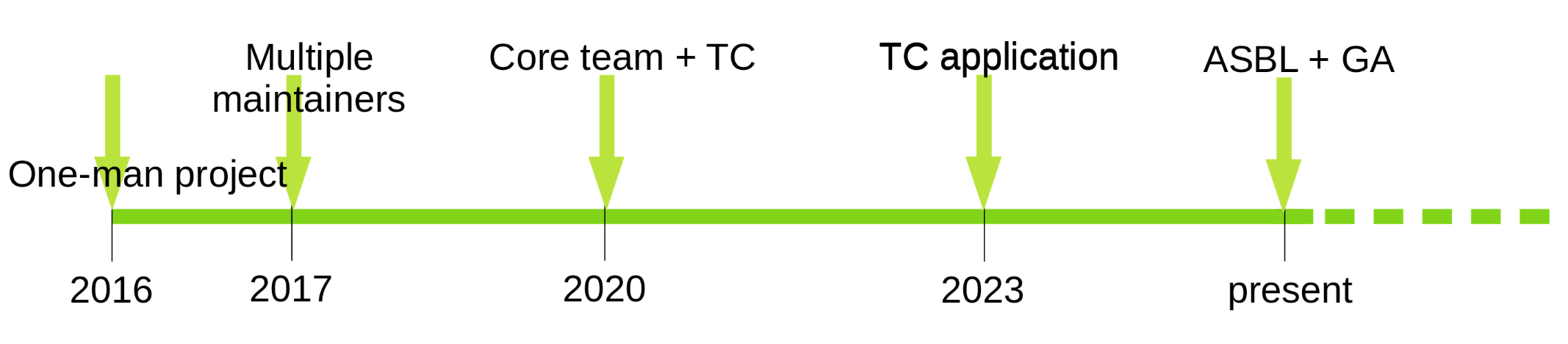
As we have reported before, the Nura team has been working for a long while in the creation of a legal entity. That process was recently finished, and there now exists a legal entity whose goal is to support our mission! The entity is registered in Belgium as an ASBL ("Association Sans But Lucratif", or "not-for-profit association"): the NURA PROJECT ASBL!
Thanks to Antoine, Luca, Pablo, Rob, and Stefan for the planning and funding of the entity, and coordination of the follow-up bureaucracy!
Why Belgium and an ASBL?
Our main interest to have a legal entity was for it to represent the project, as therefore be able to sign agreements, or receive grants. The most popular kind of legal entities in our FOSS ecosystem are US charities, also known as 501(c)3, and German associations, or e.V. Unfortunately both have, in our view, quite some drawbacks:
- The current US political situation generally makes it unwise for a project like us, working on sustainability and user empowerment, to setup an entity there. In addition, US charities are not associations, but corporations. Although it might seem like a legal detail, it means that the structure is designed to protect the entity itself, and there are a lot less guardrails than in European associations. We would have to come up with our own custom governance, and the membership would still be less protected vis-a-vis the Board than in European associations.
- The German bureaucracy is considerably famous for its complexity and love for in-person and on-paper work. It is also very German-language centric, which makes it hard to even find professionals that can support associations in languages other than German. On top of that, the German tax rules for associations are very strict, making it practically impossible to have any economic activity, and the German tax authority is not very open to consider FOSS as a charitable activity.
Overall, we were not very satisfied with these options. So we did some research on European non-profits (most of the team residing in Europe was the main reason), asked on the Fediverse, and talked with people interested in the topic. After all those discussions a new kind of legal entity, the AISBL, seemed the most relevant for us:
- It comes with strong legal guardrails, like requiring a General Assembly.
- Other than the initial registration, which needs to be done in paper and in French or Dutch, most other bureaucracy in Belgium can be done online and in English.
- In order to sell goods, or provide paid services, it is as simple as requesting a VAT number, and Belgian associations follow very similar legal requirements to those of companies.
- There is an alternative version to the AISBL, the ASBL, which requires less bureacracy for creation, while imposing greater governance requirements, but also being a bit more annoying to manage from the distance.
- Although less common than German e.V. there are still some entities around us using this legal form: the Eclipse Foundation and FreeCad, both of which provided good background and advise to us. Special thanks go to Yorik the FreeCad Project AISBL secretary for his support in all our project!
So after checking for other options, like cooperatives, Spanish associations, or Dutch Stichtings, and discarding them for different reasons (for-profit, Spain focused, and non-democratic, respectively), we chose the Belgian AISBL as our preferred entity.
In the end, due to the complexities and time-consuming requirements for the creation of an AISBL, we went for the non-international version, the ASBL[^1] which has now been created.
You can find more details on the original decision-making project here.
Consequences
The main consequence of creating a legal entity is that we now have legal rights: we can sign things in the name of the project, but also legal obligations: we need to regularly report our activity to the state, and potentially also pay taxes.
For example, without a legal entity, we were unable to claim the money granted to us by the FLOSS/Fund, which we are now working on claiming. We are also working in other opportunities, and hope to be able to bring in more news before the end of the year.
At the same time, we will now have to pay our own accountants, bank accounts, and take care of our legal obligations, instead of delegating them to our fiscal host. This will add some overhead, but also remove a dependency in our decision-making and execution chain that we hope will be worth as we keep growing.
Finally, our governance structure and processes are now constrained not just by our wishes and dreams, but also by Belgian law. Although making some things less flexible, this is also a warranty that the legal entity is legally required to serve the project.
Work ahead
Even though the legal entity is now registered, there is still a ton of work ahead. We are in the process to create a bank account and find some accountants and legal advisors to help us navigate the bureacracy ahead. We are also working on adapting our community governance to the new legal situation of the project.
Eventually, we also need to make a decision on whether to keep using OpenSourceEurope as our fiscal host, or move all the money and donors to our own Independent Collective. Do not worry though, we will keep using OpenCollective for managing our finances transparently!
If you appreciate the work we're doing with Nura and want to support us, consider contributing financially via OpenCollective.
[^1] You can read more about the differences between ASBLs and AISBLs here.